


What debt collection costs you excluding the debt collection itself
The intention to pay that is lost
The window of opportunity for a debtor to agree to pay is short. If they encounter a technical obstacle, they won’t come back. You’ll call them back in ten days, with a different mindset, and this case will have cost you twice.
This isn’t a problem with payment methods. It’s a problem with what happens the second the first attempt fails.
The end-of-month project
In a traditional organization, the payment reconciliation process is a monthly task: you retrieve a bank statement, match it against the accounting software, work out who paid what on behalf of which client, prepare the reports, and initiate the bank transfers. This work is time-consuming, carried out under tight deadlines, and it is the task where a mistake proves most costly, because any error in the reimbursement is immediately apparent to the client.
This time produces nothing. It doesn’t generate a single extra euro.
What you need to be able to show
Your clients want a clear statement of what has been recovered on their behalf. The government expects the same from your organization. And your most important clients are no longer satisfied with a contractual promise: they want to see results.
Justification is not a report that one produces. It is a state that must exist.
Collecting from a debtor: a process that doesn’t end with a refusal
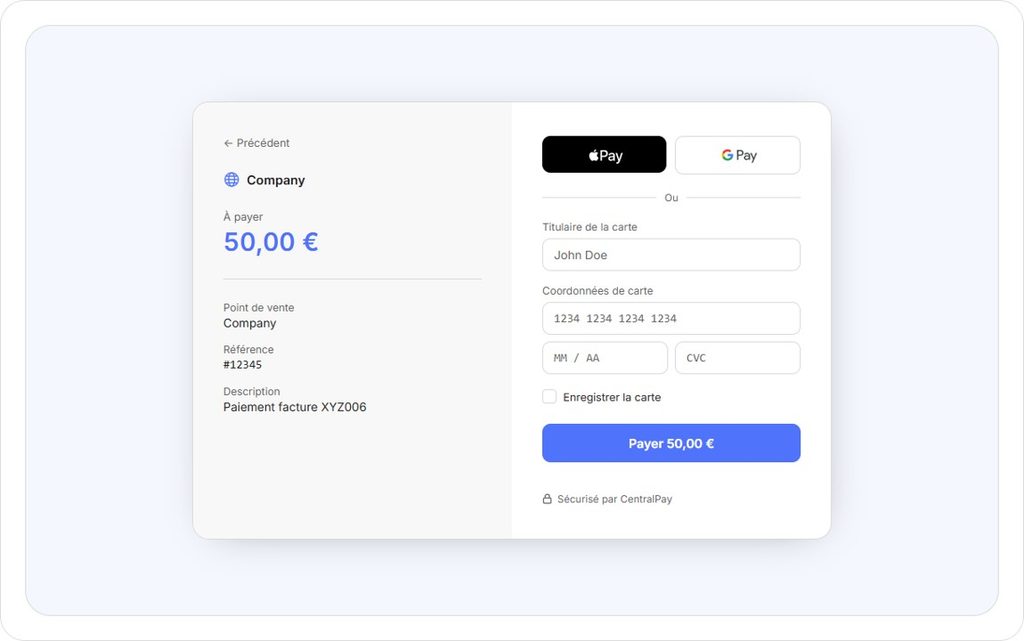
CentralPay’s payment solution for collection agencies is based on SmartForm, an online payment form designed specifically for these situations. More than just a page for entering credit card information, it is a hosted, multi-channel payment workflow that manages interactions with the debtor, particularly when a payment fails.
Making the first attempt a success
Debtors usually make payments via their mobile phones, after receiving a link by email or text message. At this stage, the main hurdle is not the amount: it is having to fetch a physical card and copy down the sixteen digits. Many payments fall through at this stage: not because the customer refuses to pay, but because the process is interrupted.
Apple Pay and Google Pay eliminate this step. The payer authenticates using a fingerprint or facial recognition, without having to enter anything or leave the payment flow. In most cases, strong authentication is handled by the device itself: there is therefore no additional screen on which the user could abandon the transaction.
Both of these options are now available in the CentralPay form, including for setting up a payment schedule and paying in instalments. This is a key feature in an industry where debts are rarely settled in a single transaction.
When the payment fails, the flow offers an alternative route
On a standard payment page, a declined transaction marks the end of the process. The debtor sees an error message, closes the page and returns to the reminder queue. The debt collection agency has lost a confirmed intention to pay.
At CentralPay, a declined transaction is a branch in the flow. The flow immediately offers:
- another card, whether newly added or already saved in Apple Pay or Google Pay,
- a bank transfer, either a standard one or one initiated via one’s bank,
- the establishment of a payment schedule, to spread out the payment deadlines, where the firm has provided for this in its plan.
He then reconstructs the debt and records the payments, regardless of the route taken and the number of transactions required to settle it.
Partial authorisation: collecting what the debtor is able to pay
This is the most specific mechanism of our payment solution for debt collection agencies. When a debtor requests payment of a debt and their bank refuses the full amount but returns the available balance in the account, the process captures this balance instead of exiting with a refusal.
On an outstanding debt of 1,500 euros, this represents 600 euros collected rather than nothing. And the remaining 900 euros is not lost: it remains part of the payment request and can be settled by other means – either immediately, as part of the ongoing process, or at a later date. There is no need to recreate anything, and the debt continues to be tracked as a single item. The debt collection agency can also include a payment schedule in its collection plan, setting out the terms for settling the balance itself.
The mechanism relies on the response from the issuing bank, which must return the available balance rather than a flat refusal. If it fails to do so, the workflow switches to its other branches. No single mechanism covers every situation; it is the combination of these mechanisms that determines the success rate.
Nuance matters. It is not the funds in the debtor’s account that are debited: it is their intention to pay that is honoured to the extent that it could cover the amount due. They asked to pay, their bank replied that there were insufficient funds, yet this does not mean the process starts from scratch. For a debt collection agency, the difference between a partial payment followed by a payment plan and a flat-out refusal is considerable: both in terms of recovery rates and the number of cases that need to be reprocessed.
To pay back to the creditor/principal, without spending all day on it.
A payment solution for collection agencies should not stop at collection: that is only the first half of the job. The second is payout, and this is where the less visible gains are found.
The rapprochement is no longer a work in progress
When the payment goes directly to your client, the collection and payment are part of the same chain. Each payment is linked from the outset to the client for whom it was collected, and the payment is accompanied by a statement of the payments it comprises.
The link between what went in and what came out is not recreated after the fact. It exists.
In practical terms, the end of the month changes: you no longer prepare the statements, you review them. And a creditor who entrusts several mandates receives a transfer for each mandate, each one with its own details: they don’t have to allocate anything on their end either.
Your clients are paid on time, without anyone even thinking about it.
The payment must be made within one month of receipt of the funds, unless otherwise agreed with your client. Currently, this timeframe depends on someone’s vigilance.
With a parameterized order, it becomes a property of the system. You decide the frequency, the composition of each payment, and when it is sent; what disappears is the risk of discovering an overpayment after the fact.
Nothing goes to the wrong beneficiary
Before each payment, we check that there are no obstacles: that the registered details correspond to the account holder, and that there are no alerts against the beneficiary or the transaction.
A transfer sent to the wrong place is difficult to rectify, and it shows up on the principal’s end. This type of incident costs the mandate, not just an accounting correction.
Your fees never cross paths with your creditors’ funds.
You have two separate payment accounts. The first receives funds collected on behalf of third parties: these funds enter and leave this account without any processing, and no fees are ever debited. The second account is dedicated to your business operations, and it is the only one from which service fees are deducted.
A contractual clause stipulating the same thing can be breached by a configuration error, and this must then be proven. Here, no proof is required: the account dedicated to third-party funds does not allow any outgoing transactions other than the disbursement, and each transaction is logged.
In all cases, nothing is charged to the debtor. Your fees are borne by your client.
Two possible destinations, depending on your organization
The funds are disbursed in gross form. What varies is where they go, and practices are not uniform.
- To your client, the creditor. They receive the full amount recovered on their behalf, and you invoice your fees separately. This is the model preferred by most major clients, who want to see the gross amount recovered and treat your compensation as a separate service. It’s also the one that eliminates the end-of-month workload.
- To your own dedicated third-party fund account. You then distribute the funds to your clients according to your own agreements. This is standard practice for portfolios of numerous, small clients, where separate billing for each case would be disproportionate. The allocation and reporting then remain with you.
The choice is made on a client-by-client basis, not for your entire portfolio.
What changes when you respond to a call for tenders
It is the least obvious, yet most significant, benefit.
Large clients are benchmarking, comparing, and re-evaluating. They no longer simply ask for a collection rate; they want to see what has been collected on their behalf, when, and how it was paid out. This demand is growing, driven by the digitalization of their own invoicing cycle and by pressure on their payment deadlines.
A firm that produces this report in three clicks is not in the same position as one that compiles it in three days. Traceability ceases to be a requirement to be met and becomes a selling point to be presented.
In other words: what was a burden becomes a reason for being chosen.
Integrate with business software without changing tools
A payment solution for debt collection agencies doesn’t replace your existing business software; it connects to it. You don’t need to change your management software for a single payment issue.
Your software retains the logic of accounts receivable management and triggers payment events via an application interface. You remain the account holder. CentralPay manages the financial chain: enrollment, mandate signing, holding of funds as an electronic money institution, controls, and execution of the payment.
The debt collection agency retains its tools, working practices and case management system. The changes take place downstream of its software.
Payment solution for debt collection agencies: an overview
A payment solution for debt collection agencies is not judged by the number of payment methods it offers. It is judged on two things: what it manages to collect when the first attempt fails, and what it makes visible in the account where creditors’ funds are held.
CentralPay is an electronic money institution authorised by the ACPR. Customer funds are held in segregated accounts, separate from the institution’s own funds.
Do you run a debt collection agency and are looking for a payment solution tailored to your business? Our teams will assess your collection and remittance process and send you an initial written analysis.