


The subscription payment solution, truly automated
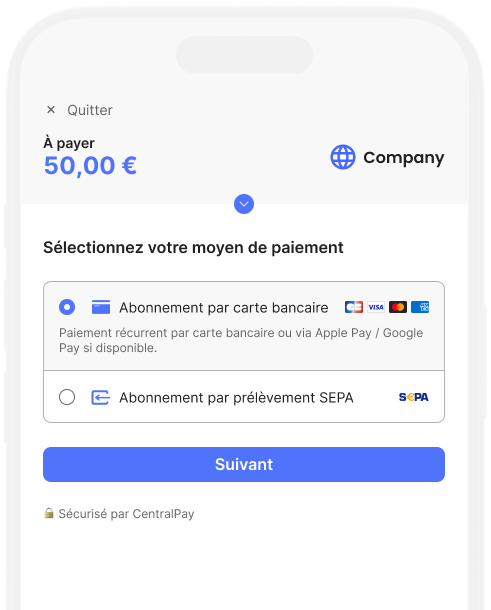
Register bank cards or SEPA mandates, set due dates and let the CentralPay platform debit your customers at the right time.
Response within 24 hours !
recurring revenue
of failures and retries
no hidden fees
Two sampling methods, to choose from
Credit card payment
Collect recurring payments by credit card on agreed-upon due dates, without any customer intervention. Ideal for services with automatic renewal or plans under €150.
Strong cardholder authentication upon subscription
Automatic direct debit triggering at each due date
Customer notifications for any necessary updates
SEPA Direct debit
Collect subscriptions via SEPA direct debit. Ideal for services or plans over €150, this payment method guarantees stability and visibility over your recurring revenue.
Sign the e-mandate from a secure portal
Automatic triggering based on the due date
Monitoring payment statuses (accepted, rejected, disputed…)
Learn more


Subscription payment,
fully automated
Reduce friction and automate every step of your subscription payment journey.
Dynamic planning
Schedule SEPA or credit card direct debits, with immediate or delayed start, depending on your subscription models.
Automated tracking
As a due date approaches, notify the customer and automatically debit them according to the terms of the payment schedule.
Scheduled reminders
Configure retries in case of failure. Decide which scenarios CentralPay will perform automatically.
Response within 24 hours !
FAQs
Questions about the subscription payment solution?
The subscription payment solution is aimed at merchants, with:
- Fixed recurring subscriptions: Periodic payment of a defined amount, which is fixed until the customer cancels (e.g. monthly or annual subscription).
- Variable recurring subscriptions: Periodic payment of a defined sum, where the amount to be paid varies (e.g. pay-as-you-go subscription, freemium model, discount subscription, etc.).
Setting up a SEPA Direct Debit differs from setting up a credit card payment.
A SEPA Direct Debit requires the creation and signing of a SEPA mandate, specifying the authorized payment terms.
The merchant collects the necessary information to create the mandate (name, surname, IBAN, BIC, etc.) and sends it to the customer.
- The payer checks the information and signs the mandate.
- Funds are automatically debited according to the payment plan.
In the case of a charge to a bank card, no contract is signed between the merchant and the cardholder.
- Payers enter their card code, expiry date and CVV on the dedicated form.
- It operates the 3DSecure process to authenticate the transaction.
- The funds are automatically debited from your credit card according to the payment plan.
Several factors need to be taken into account:
- Activity: The average amount of your direct debits, the desired sales path and the habits of your target customers.
- Location: Depending on the country you're addressing, make sure you choose the direct debit type adapted to those areas.
- Potential risks: Particular attention must be paid to the ceilings and expiry dates of the supports.
- Costs: Payment by credit card and SDD involve different costs, depending on the risks and external charges associated with their use.
In general :
- If you offer B2C and B2B subscriptions for small amounts, opt for credit card direct debit.
- If you offer B2C and B2B subscriptions in larger amounts, payment by SEPA direct debit will be the most suitable.
Several factors can cause withdrawal failures (insufficient funds, rejections, etc.), and impact your cash flow. CentralPay lets you set up new payment attempts, made in the event of failure, to automatically collect your outstanding receivables.
Deploy subscription payments with CentralPay
Our teams analyze your architecture and offer a compliant, ready-to-deploy solution.