


Three realities that weigh on the payment of a customer invoice
These realities are familiar to every manager or accounting professional. They impact every invoice issued, regardless of the client’s profile or creditworthiness. This is precisely what a good customer invoice payment solution must address.
Payment deadlines are regulated by law, not by your terms and conditions.
Article L.441-10 of the French Commercial Code caps the payment period between professionals at 60 days from the invoice date, or 45 days end of month if the contract stipulates it. After this period, late payment penalties are automatically due, without prior notice: at the rate set by your general terms and conditions, with a minimum of three times the legal interest rate, or, failing that, the ECB refinancing rate plus 10 percentage points.
In addition, a fixed penalty of €40 per late invoice is automatically due (Article D.441-5). The absence of these details on the invoice is itself punishable, up to €375,000 for a legal entity (Article L.441-16), and the DGCCRF (French Directorate General for Competition Policy, Consumer Affairs and Fraud Control) can impose an administrative fine of up to €2 million.
Compliance with these deadlines and proof of the right to penalty in the event of a dispute depend directly on one thing: knowing, with certainty, when a payment has actually arrived.
The cash receipt status becomes a tax-related factor.
Since September 1, 2026, the french electronic invoicing reform requires all VAT-registered businesses to be able to receive electronic invoices. Large companies and mid-sized enterprises (ETIs) must also issue their invoices electronically and transmit their transaction data to the tax authorities (e-reporting). This requirement will extend to SMEs and very small businesses (TPEs) on September 1, 2027.
One aspect often goes unnoticed: for services where VAT is due upon receipt of payment, the “Paid” status must itself be transmitted to the tax authorities by the invoice issuer’s Approved Platform. Knowing precisely when and how much a customer has paid is therefore no longer simply a convenience for internal management; it is mandatory data that the company must be able to produce and transmit.
Trace each transfer, identify each payer
A B2B client most often pays by bank transfer, sometimes several days after receiving the invoice, with a description that doesn’t always include the reference number, or by paying several invoices at once in a single transfer. Reconstructing who paid what then becomes a manual task, done under time constraints, which further delays the confirmation of payment.
It is this combination – a precise legal and fiscal framework and a collection that largely depends on the responsiveness of the customer – that led CentralPay to design a customer invoice payment solution designed to limit delays and failures upstream rather than to deal with them once they have been observed.
A smart checkout process, designed to limit delays and failures
The value of a customer invoice payment solution isn’t measured by the number of payment methods listed on a page, but by what it does when the first attempt fails, or when the customer simply delays. The CentralPay payment page is a hosted, multi-mode payment journey designed to maximize the chances of payment at every stage, rather than simply displaying bank details.
The right payment method, at the right time
Instant bank transfer, business credit card, SEPA direct debit mandate: the customer pays using their preferred method. This diversity, consolidated into a single process rather than spread across multiple channels, is what makes the difference in the first-time success rate.
When a payment fails, the process offers an alternative
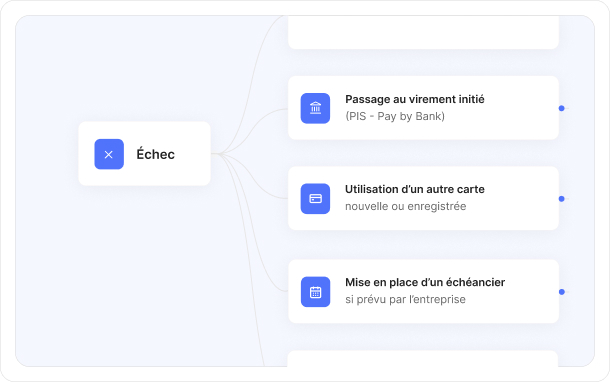
A card refusal, an interrupted session, a bank blocking a transfer: on a traditional payment page, that’s the end of the line. The customer sees an error, closes the page, and the invoice falls back into the dunning queue. With CentralPay’s customer invoice payment solution, failure opens a branching path: a transfer initiated from the customer’s banking app, another card, or the implementation of a payment plan when the scenario allows. Each attempt, regardless of the path taken, adds to the same invoice file rather than starting from scratch.
Follow-up calls based on the actual payment status
Nothing damages a business relationship more than a reminder sent for an invoice that’s already been paid, or conversely, an overdue invoice that slips through the net because the reconciliation process wasn’t followed. The CentralPay workflow synchronizes reminders with the actual payment status: a notification is sent as the due date approaches, with the payment link attached, and stops immediately as soon as payment is received, even if it’s partial.
Match each payment to the correct invoice to ensure reliable cash receipt data
A customer invoice payment solution does not stop at the collection of payment: it is also necessary that each payment received be linked, without re-entry, to the correct invoice, and that this linking produces usable data.
The native and instantaneous rapprochement
With the CentralPay customer invoice payment solution, each customer, invoice or entity can be assigned a dedicated IBAN, or a structured reference: upon receipt of the transfer, the reconciliation with the corresponding invoice is instantaneous, even when the bank description is incomplete.
Group transfers, a common occurrence in B2B
When a customer pays several invoices in a single transfer, the total amount is automatically allocated between the invoices concerned, without manual reconstruction afterwards in a spreadsheet.
Traceability that also contributes to your compliance
Native reconciliation isn’t just for accounting convenience: it provides, in real time, the payment receipt data that the electronic invoicing reform mandates for services subject to VAT on a cash basis. The “paid” status of an invoice becomes available information as soon as payment is received.
A customer invoice payment solution that integrates with your business tools
A customer invoice payment solution doesn’t replace your invoicing software or ERP; it connects to it. CentralPay offers native connectors to common management tools (Cegid, Sage, Business Central, etc.), an API for custom integrations, and file import/export for more ad-hoc transactions. Your teams keep their existing tools and processes; the change occurs downstream, in the payment processing itself.
Customer invoice payment solution: in summary
A customer invoice payment solution isn’t judged by the number of payment methods it offers. It’s judged by two things: what it manages to collect, even when the first attempt fails, and what it makes usable as payment data for your legal and tax obligations.
CentralPay is an electronic money institution authorised by the ACPR. Customer funds are held in segregated accounts, separate from the institution’s own funds.
Looking to improve the reliability of your customer invoice payments? Our experts are available to discuss our customer invoice payment solution.