



Understanding co-branding and the requirement for free choice
Interoperability and transparency in payments within the European Union are governed by European Regulation (EU) 2015/751, also known as the IFMR (Interchange Fee Regulation). This regulation establishes two fundamental rules regarding the application of network choice for co-branded cards:
- Merchant preselection: the card issuer or merchant can define a default scheme for processing the transaction.
- The payer’s freedom of choice: the cardholder retains the fundamental right to reject the preselected option and manually select the second network available on their payment card.
The interface presented to the customer—whether physical or virtual—must therefore clearly display all available options so that the user’s intent can be carried out before the funds transfer is finally confirmed.
Why is choosing the right network for a co-branded card so important?
The choice of payment network goes far beyond a mere cosmetic preference. It has direct consequences for the entire chain. To understand this issue, we must analyze how traffic routing directly impacts the merchant’s profitability and the robustness of its infrastructure.
Impact on acquisition costs
For an e-commerce merchant, every cent counts when it comes to the overall cost of processing payments. Transactions made with co-branded cards (such as CB/Visa or CB/Mastercard) are subject to different fee schedules depending on the network used.
In practical terms, when a customer confirms their shopping cart, the selected payment scheme determines the amount of interchange fees and network fees charged to the merchant. The domestic CB network generally offers more favorable terms for domestic transactions than international networks. By optimizing the network selection for a co-branded card so that the most advantageous network is applied by default, the merchant directly reduces their acquisition costs.
Performance and approval rates
The payment acceptance rate is a vital metric for e-commerce conversion. A payment that is wrongly declined results in a lost shopping cart and a potentially disappointed customer.
The choice of payment scheme has a direct impact on this performance. The national CB network benefits from direct connectivity to the authorization systems of French issuing banks, which maximizes the chances of success for a domestic transaction. Conversely, for a purchase involving cross-border elements or foreign currencies, using an international payment scheme is often more effective. Offering a choice helps maximize the authorization rate depending on the type of order.
Infrastructure resilience
No network is immune to temporary technical issues, major maintenance, or congestion during seasonal traffic peaks (sales, the end-of-year holidays).
Having a co-branded card and a payment architecture capable of switching between payment schemes provides an essential safety net. If the international network initially used experiences latency or a temporary outage, the ability to route the transaction to the alternative network ensures service continuity. For the merchant, this prevents an abrupt interruption in the conversion funnel and protects revenue from technical issues with the networks.
Implementing network selection for a co-branded card in e-commerce
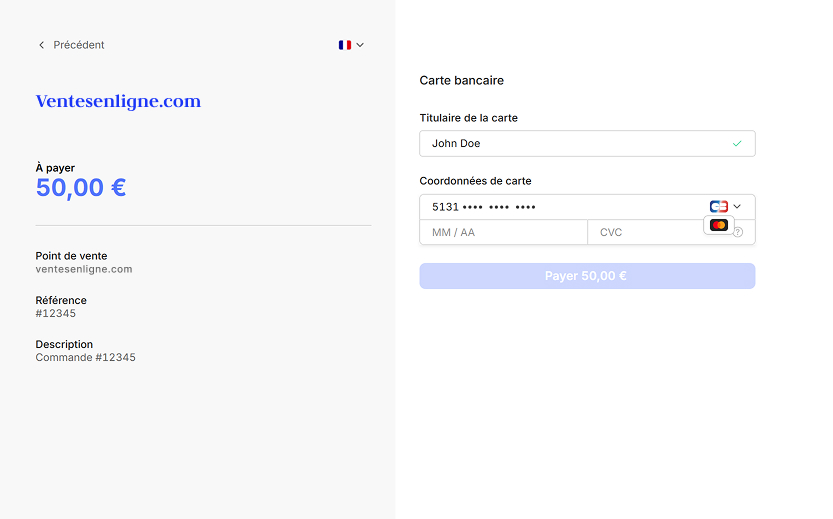
When making an online purchase, the process for selecting a network for a co-branded card involves either entering the cardholder’s payment information or analyzing the card’s BIN on the payment page:
- Card Detection: as soon as the first digits of the credit card number are entered, the payment gateway identifies the card type (debit card, credit card, or prepaid card) as well as whether it is a co-branded card.
- Default layout display: the interface applies the setting configured by the purchaser or the e-merchant.
- Providing the selector: to comply with regulations, the form must visually display the second available option. The customer must be able to click on the alternative option to change the payment routing before initiating the authorization request.
What about Apple Pay for online and in-app purchases?
The rise of mobile payments does not exempt mobile wallets from complying with European regulations. Apple’s Cards app includes multi-network support for cards issued by French banks.
The network selection for a co-branded card in Apple Pay is handled seamlessly when finalizing an order on a website or in a mobile app.
When the shopping cart is initiated via Apple Pay, the payment summary displays the saved card. If the card is a co-branded card, a dedicated button for changing the active network appears directly below the card image. The payer can manually switch between the CB network and the international network with a single tap, then confirm the transaction using their fingerprint or facial recognition.
What about in-store payments (POS)?
From a regulatory standpoint, the principle remains exactly the same in brick-and-mortar stores as it is in e-commerce: the merchant sets the default payment method on their payment terminal, and the customer retains the right to choose the other option.
It is in the user experience where the difference is most noticeable:
- Online: the visual interface clearly displays the available diagrams and provides a button for manual selection before confirming the transaction.
- In physical stores: the contactless or insert-to-pay process is designed to be extremely fast. The payment terminal therefore automatically applies the priority set by the merchant. For the payer to exercise their choice, they must perform a specific manual action on the terminal’s keypad (or with the merchant) before presenting their card or smartphone, which makes the transition less intuitive in practice.
In short: a strategic imperative for players in the payments industry
Far from being a burdensome regulatory requirement, effectively managing the network selection for a co-branded card is a fundamental driver of payment optimization. For an e-merchant, neglecting this feature means relinquishing control over acquisition costs and depriving themselves of key tools for improving the customer experience.
Offering a seamless, transparent, and compliant brand selector demonstrates essential technical maturity. As shopping habits become increasingly digital, the ability of payment infrastructures to provide this frictionless freedom of choice will become an essential standard for e-commerce performance.