


What is a marketplace ?
A marketplace is an online platform that connects sellers and buyers.
The marketplace centralizes products and services from various sellers within a single sales space. The platform takes care of everything: catalog and highlighting of offers, orders and payment, delivery, customer relations, and much more.
This model facilitates access to a diverse range of products for customers and allows sellers to benefit from the platform’s visibility and technical infrastructure.
Marketplace payment process : the different stages
The marketplace payment process is handled by the platform itself.
The principle remains the same. We are talking about collecting payments on behalf of third parties: during a sale, the platform collects the entire amount, deducts its commission before paying out its share to each seller concerned.
Here are the key steps in marketplace payment management:
- Placing the order : the customer selects one or more products offered by different sellers and validates their order on the marketplace.
- Payment processing : The marketplace collects the customer’s payment via a payment service provider. The funds are then secured in a dedicated account.
- Commission management: the platform automatically deducts its commission.
- Distribution and payments to sellers: the amount paid is distributed and paid to the various sellers involved in the sale, according to a schedule and specific rules (once the delivery conditions have been met, for example).
- Refund management: the marketplace can also intervene in the event of a dispute (order cancellation, dissatisfaction, etc.) in order to fully or partially refund a customer.
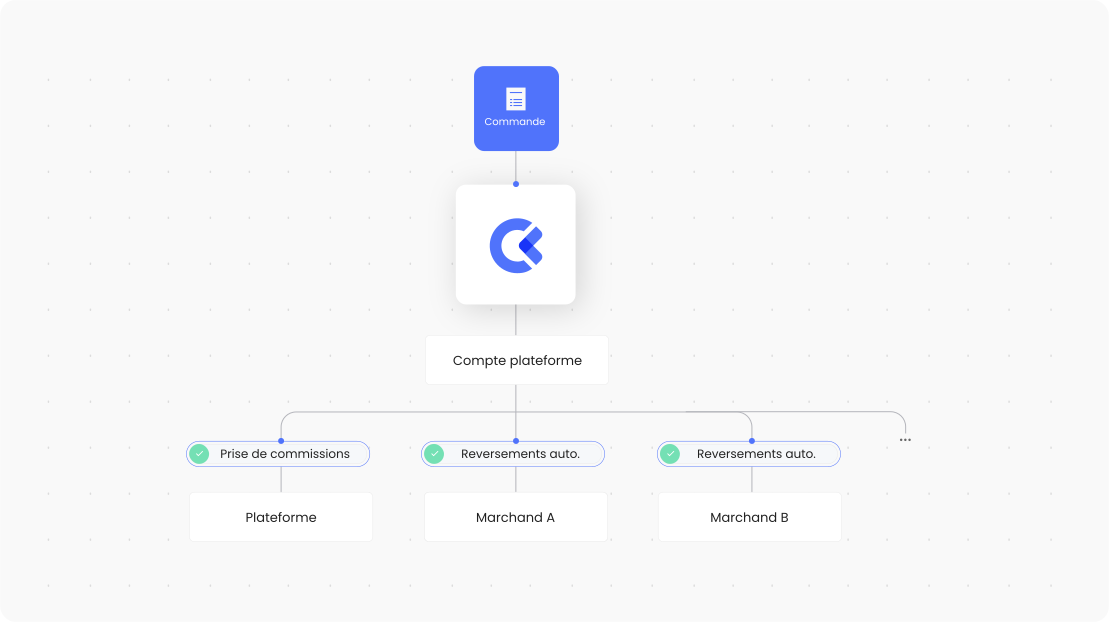
In practical terms, a well-structured marketplace payment process ensures transaction security, regulatory compliance, and a seamless experience for all users.
Marketplace payment process : the importance of a payment provider
The marketplace payment process is more complex than it seems. It’s not simply about processing a payment, but a regulated activity involving the collection of funds on behalf of third parties.
The payment service provider (PSP) collects the payment before transferring the funds to the seller, acting as a trusted intermediary that ensures the proper execution of the transaction for both parties.
Using a PSP for a marketplace offers many advantages :
- Multiple payment methods : the provider offers different payment methods, which makes purchasing easier for customers and helps to increase the conversion rate.
- Security and compliance : an approved PSP controls the funds, thus reducing financial risks for the marketplace, sellers and customers.
- Optimized multi-basket management : a PSP can automatically distribute a customer’s payment between multiple sellers and your platform, simplifying commission management and ensuring secure distribution of funds.
- Refund management : The payment provider easily manages cancellations and refunds (full or partial) while adjusting seller payments.
- Reporting and transaction tracking : The PSP provides marketplaces with detailed dashboards and reports to track sales, commissions and financial flows.
Marketplace payment process : compliance
The marketplace payment process must comply with the European PSD2 (Payment Services Directive 2), which governs online payments and aims to secure transactions.
PSD2 imposes several obligations on marketplaces and payment service providers (PSPs):
- Know Your Customer (KYC/KYB): During onboarding and throughout the relationship, the marketplace must ensure that each seller is properly identified and verified to combat fraud and money laundering.
- Fund traceability: A marketplace collects customer payments, deducts its service fees, and distributes funds to sellers. The flow diagram must be precisely defined so that each transaction can be traced.
- Strong Customer Authentication (SCA): The marketplace must comply with the obligation to strongly authenticate the majority of payers on its platform.
Payment is therefore a fully-fledged regulatory issue, closely monitored by the relevant authorities. To be compliant, a marketplace has three options:
- Becoming a Payment Institution: A marketplace can choose to manage its own payments, but this requires becoming a payment institution. The process of obtaining authorization from the ACPR is lengthy, highly regulated, and requires significant resources to meet regulatory requirements.
- Benefit from an exemption from authorization: In very limited cases, an exemption may be granted. This applies only to platforms with a restricted offering or a small user base.
- Use a payment service provider (PSP): Most marketplaces choose this option. The PSP, already authorized by the ACPR, provides the payment infrastructure, secures financial transactions, and distributes funds among sellers. This solution is quick to implement and facilitates platform deployment.
CentralPay : the marketplace payment provider
CentralPay is a payment service provider (PSP) serving B2C, B2B, and C2C marketplaces and multi-vendor platforms. CentralPay provides merchant onboarding, payment processing, security, and automation services, while ensuring full compliance with applicable regulations.
Why choose CentralPay for your marketplace?
- Easy onboarding: simplified portal, hybrid identity verification protocol combining automation and human oversight.
- Multiple payment methods: credit card, bank transfer and direct debit, Pay by Bank, Apple Pay, Google Pay, and many more.
- Security protocols: 3DS, anti-fraud module, PCI-DSS certification, tokenization.
- Multi-sharing payments: commission collection and automatic distribution of funds from third-party sellers on the platform.
- Comprehensive automation: sending customer notifications, webhooks and seller alerts, customer relationship and dispute tracking.
The CentralPay marketplace payment process simplifies payment management, secures financial flows, and improves the user experience while ensuring regulatory compliance.