


The next-generation direct debit
payment solution
Digitize and automate your SEPA direct debit payment management. Collect mandates online, trigger SEPA Direct Debit mandates, and manage each payment due date from a single platform.
Response within 24 hours !
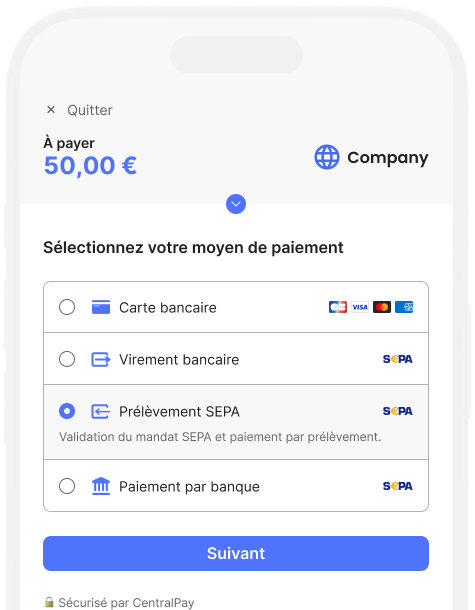
Electronic direct debit
mandates
Recurring or one-time direct debits,
with no limit
Controlled transaction costs,
no hidden fees
A complete solution
for your customer payments
Response within 24 hours !
Your entire sample collection process, fully digital
One-time direct debit
Collect payments from your customers in a single installment, without setting up recurring mandates. A simple and secure alternative to bank transfers or checks: you pre-register bank details for potential future payments.
Subscription
Set up SEPA direct debits with defined frequency, amount, and duration at the time of creation. CentralPay triggers each payment at the right time, manages reminders in case of rejection, and updates the status in real time.
Learn more
Installment
Link each bank withdrawal to an invoice or order. Reconciliation is automatic upon receipt of payment. Export your data to your ERP or accounting software without manual re-entry.
Learn more

Automated direct debit
management
Creating and signing e-mandates
Send your customers a link to collect their SEPA Direct Debit mandate online. The mandate is signed, archived, and activated in seconds, without any paperwork to process.
Dynamic notifications
Reduce disputes by automatically notifying your customers before each bank debit. Configure the timeframes, distribution channels (email, SMS), and templates.
Automated tracking
Automate follow-up and communication tasks. As a deadline approaches, the client is notified and then charged according to the terms of the mandate.
Programmed retry
Set up new payment attempts in case of failure. You decide the frequency that CentralPay will automatically perform, at the appropriate time.
Response within 24 hours !
SEPA Direct Debit
for each business context
Collect payments and pay your merchants
- Express merchant onboarding
- Payment orchestration powered by CentralPay
- Management of marketplace commission collection
- Automated payouts
Acceptez plus de paiements en ligne
- Boost card payments with Apple Pay and Google Pay
- Accept instant transfers, Pay by Bank, and SEPA direct debits
- Quick integration via plugin, SDK, or hosted payment page
- Built-in data security and anti-fraud services
Faites payer vos factures, sans effort
- Payment requests via email and SMS, with automated reminders
- Automated processing of bank transfers, direct debits, and card payments
- One-off payments, deposit/balance splits, and scheduled payments
- Synchronization with ERPs, software, and business tools
Deploy complex models, simply.
- Crypto-Asset Service Providers (MiCA): fiat-to-crypto payment rails →
- Crowdfunding (PSFP): regulated fundraising and payouts →
- Software vendors: partner model and rapid integration →
- Custom projects: scoping and expert support
FAQs
Questions about direct debit payment solutions?
A direct debit payment solution enables businesses to collect funds directly from their customers' bank accounts. It handles the entire process, from collecting the SEPA mandate to executing debits and tracking transactions.
This solution is particularly well-suited for recurring payments—such as subscriptions, membership fees, or installment plans—as well as one-off payments. By automating SEPA direct debit operations, it simplifies the management of customer collections.
By centralizing SEPA mandates, payment schedules, and debit statuses, the direct debit payment solution allows businesses to save time, reduce administrative tasks, and improve cash flow monitoring.
A direct debit payment solution relies on the SEPA Direct Debit scheme, a payment method that allows a business to debit a customer's bank account with their authorization. Once a SEPA mandate is signed, debits are scheduled according to the defined frequency—either as a one-off payment or recurring installments.
At each scheduled payment date, the solution automatically transmits SEPA direct debit instructions to the banking network. Funds are then debited from the customer's account and credited to the business's account. Transaction statuses are updated in real time to facilitate the tracking of incoming payments.
A direct debit payment solution also automates SEPA mandate collection, payment scheduling, the handling of rejected payments, and payment reconciliation. Businesses thus benefit from a reliable, secure, and fully digitized payment collection process.
SEPA Direct Debit (SDD) is suitable for any business that collects recurring or deferred payments: subscriptions, membership fees, rent, B2B invoices, etc. With CentralPay, manage mandates, due dates, rejections, reconciliations, and refunds from a single platform.
SEPA Core Direct Debit applies to both individuals and businesses. It allows the payer to dispute the direct debit up to 13 months after collection. SEPA B2B Direct Debit is used by public institutions to collect payments from businesses, as these payments cannot be disputed.
A customer has 13 months from the date the account is debited to contest a direct debit payment. In this case, the merchant will have to pay a fee of up to €20 to cover those charged by CentralPay's bank for each refused transaction.
The CentralPay direct debit solution enables businesses to manage all their SEPA direct debit collections from a single platform. From SEPA mandate creation and transaction tracking to the execution of debits, every step is centralized to simplify payment management.
You can automate SEPA mandate collection, schedule one-off or recurring debits, track transaction statuses in real time, and optimize your collection processes. The solution integrates easily with your website, application, or business software.
As an authorized payment institution, CentralPay supports you in deploying your SEPA direct debit solution. You benefit from a secure infrastructure that complies with European regulations, as well as technical and functional support to tailor the solution to your business needs.
Deploy direct debit payments with CentralPay
Our teams analyze your architecture and offer a compliant, ready-to-deploy solution.